Full Sail Stories
Published Jan 30, 2026
Full Sail’s Mix Palace Upgraded With 10 New Dolby Atmos Post-Production Studios
Full Sail expands its mixing facility with 10 new Dolby Atmos 7.1.4 studios, providing students immersive audio workflows.
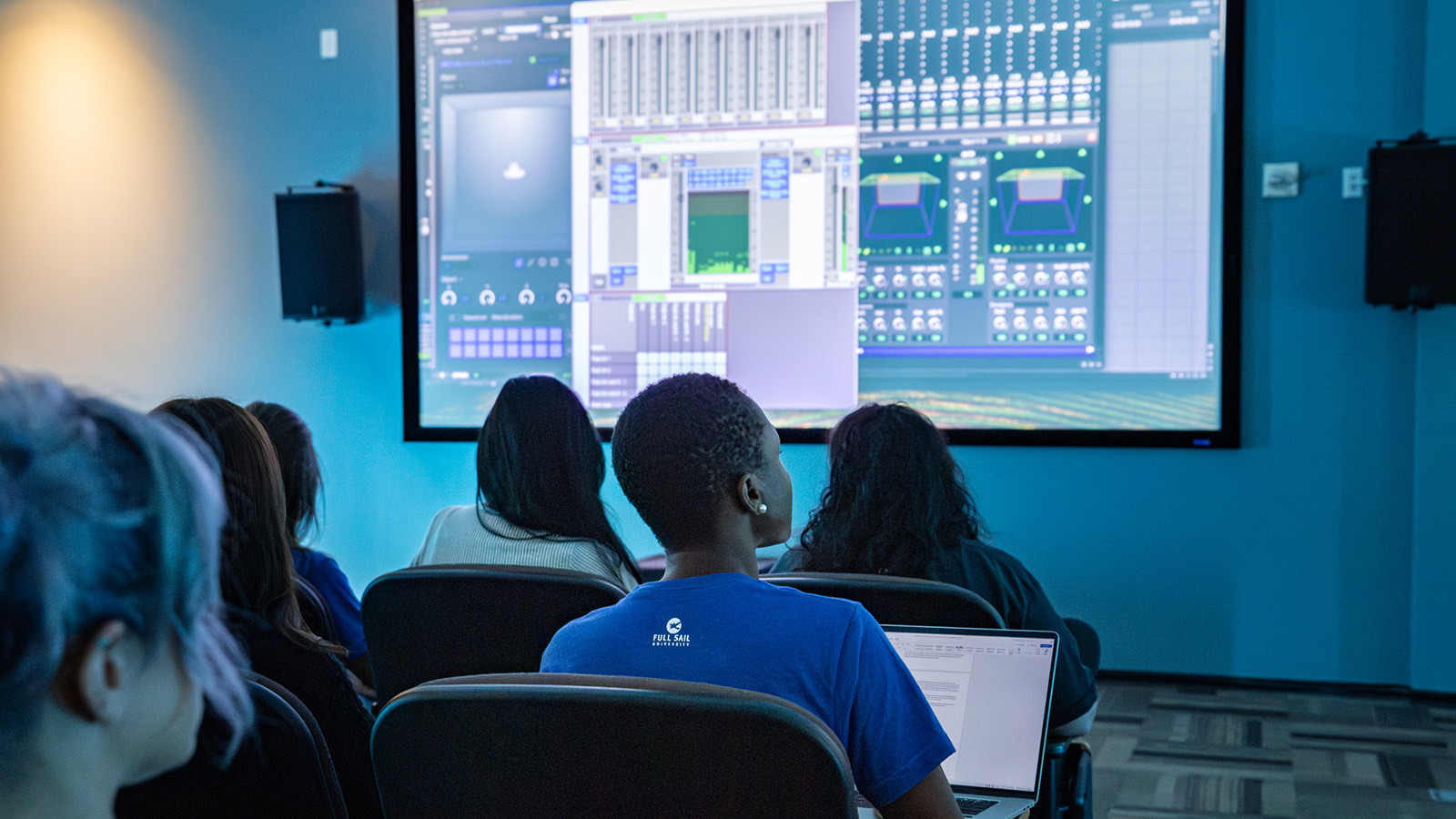
Full Sail’s Mix Palace has always been one of those spaces that quietly carries massive weight. It’s where students sharpen their ears, refine their audio mixes, and get hands-on with the same workflows powering commercial releases around the world. And now? The Palace just got a serious upgrade.
This month, Full Sail completed the installation of 10 Dolby Atmos 7.1.4 mixing rooms – a milestone that further solidifies the university’s investment in immersive audio education.
“It’s become the industry standard as a deliverable,” says Darren Schneider, Grammy-nominated producer, mix engineer, and Full Sail’s Director of Advanced Session Recording. “It’s rare that commercially released records don’t have an Atmos version.”
Prior to COVID, most film and TV audio deliverables were in 5.1 surround. But as pro engineers found themselves with time to archive and revisit classic sessions, immersive audio surged from a niche luxury to a commercial expectation for music too. Today, labels like Atlantic and RCA regularly require both stereo and Atmos masters, and platforms like Apple convert Atmos mixes into Spatial Audio for head-tracking devices.
That industry-wide shift meant Full Sail needed to rethink the Mix Palace’s post-production side – not just for professionals, but for students preparing to become them.
“The idea is to give students leverage,” says Brandon Egerton, Education Director of Audio Arts at Full Sail. “Anything we can do to give them an advantage in the marketplace, we want to make sure we do that.”
To make immersive audio rooms effective for both learning and commercial deliverables, each studio had to sound and operate the exact same way.
“These are small spaces, smaller than Dolby likes,” Darren says. “We had to figure out a way to make all 10 rooms identical.”
The solution was a custom-built cage system that houses the full speaker array, giving each room the same dimensions and sonic profile. That means students can move from one studio to another without adjusting to a different acoustic environment.
“If you worked in room 200, you could go to room 204, and 204 sounds the same and operates exactly the same,” he explains. “There are now 10 identical 7.1.4 rooms.”
Each room includes:
- Genelec speakers for pro-grade audio fidelity
- Avid MTRX and Apogee Symphony interfaces
- Dolby Atmos Renderer, Pro Tools, and advanced plugins on a house system
- USB-C plug-and-play support for student laptops using Logic Pro or Pro Tools
That last point matters more than ever. Instead of waiting for access to larger studios or post suites, students can now walk in, plug in a single cable, and instantly reference or print immersive mixes from their own machines.
While these rooms will be integrated more widely into the Recording Arts curriculum, they’re already being used by students in post-production classes and through the AMPLIFY extracurricular studio-booking program, which has seen nearly 2,000 bookings in the past year on the music-production side alone.
But what excites Darren most isn’t the gear itself – it’s the drive it ignites.
“The curriculum is the minimum,” says Darren. “That’s the starting point. Where it really gets good is when students decide to hone their craft beyond what’s required.”
Brandon echoes that sentiment, pointing to the larger meaning behind the upgrade. “The Mix Palace is a lot more user-friendly now,” Brandon says. “It allows them to experience immersive audio independently, understand the assets, and build the confidence to meet industry expectations one-to-one.”
This upgrade isn’t happening in isolation. It directly complements the Dolby Creator Lab launched in late 2024 – a classroom built for group exploration, but not for independent mixing. The Mix Palace fills that gap with a facility purpose-built for creation, iteration, and student ownership.
It’s also a signal to the industry and a win for students. Full Sail isn’t just adapting to the future of audio; it’s building it into the student experience early, thoughtfully, and at scale.
“Even five years from now, we'll still be in the early stages of what will be happening with immersive audio," says Darren. "To already have 10 identical Atmos rooms today? It’s really cool.”